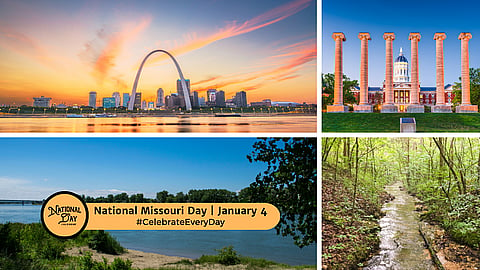
National Missouri Day
Fast Facts
- WHAT
- Shines a spotlight on the Show-Me-State, Missouri, as the 24th state to join the Union.
- WHEN
- Celebrated each year on January 4
- CREATOR
- Created in 2019 by National Day Calendar®
- VIBE
- Historical, Information, Pride
NATIONAL MISSOURI DAY
We celebrate National Missouri Day on January 4 to spotlight the exact order of its entry as the 24th state to join the Union. While the Missouri General Assembly established the third Wednesday in October as the official state Missouri Day, January 4 gives us an additional day to honor the Show-Me State. Missouri is too rich in history to celebrate just once a year, so we decided the state deserved two separate occasions to take pride in its remarkable heritage.
Understanding National State Days
Why do you have National State Days?
National Day Calendar is committed to celebrating every aspect of our nation's diverse culture and history, which is why we proudly introduced National State Days. This initiative is our way of honoring each state in the order they joined the Union, offering a dedicated day to celebrate the unique heritage, achievements, and spirit of each state.
By assigning individual days to each state, we're fostering a deeper understanding and appreciation of what makes each part of our nation unique. We invite you to join us in these celebrations, to explore, learn, and take pride in the rich tapestry that makes up our country.
Why is the date different from founding dates of states?
You might wonder why these National State Days aren't set on the actual founding dates of each state. Our goal was to ensure that each state receives its special day of celebration without overlapping with others. Historical entry dates into the Union often mean multiple states share the same founding date, like North and South Dakota. To give every state its own spotlight, we decided to stagger the celebrations throughout the year.
When did National Day Calendar start their National State Days?
The celebrations begin seven days after Independence Day, starting with Delaware, which was the first state to join the Union. This delay allows for a distinct separation from the nationwide July 4th celebrations, ensuring each state's day is its own unique event.
Each subsequent state is honored weekly, in the order they joined the Union, not when the state celebrates their founded date. This weekly cadence allows for consistent and focused celebrations, ensuring each state can plan and enjoy its special day to the fullest.
We've made exceptions for the weeks of Thanksgiving and Christmas, recognizing that these times are already rich with tradition and celebration. We want every National State Day to have the opportunity for full attention and participation.
#NationalMissouriDay
Statehood came to the Missouri as part of the Missouri Compromise, allowing Maine to enter the union as a free state and Missouri to enter with no restrictions on slavery. During the Civil War, Missouri was divided between the North and South. Because of this, half the state was serving the Confederacy and the other half was serving the Union.
Why is Missouri called the Show-Me-State?
U.S. Congressman Willard Duncan Vandiver coined the famous nickname during a speech at a naval banquet in Philadelphia in 1899:
"I come from a state that raises corn and cotton and cockleburs and Democrats, and frothy eloquence neither convinces nor satisfies me. I am from Missouri. You have got to show me." -U.S. Congressman Willard Duncan Vandiver, Missouri
Missouri borders on two great rivers and is known as the "Gateway to the West." The Mississippi River is on its eastern border, while a portion of the Missouri River is on the western border. As a result, Missouri is ideally located as a hub of transportation and trade.
The state boasts many cultural attractions from riverboat cruises to music festivals to tours of the largest brewing company in the nation. With a rich history and interesting people, Missouri became a stopping point for many migrating west. Some people stayed, while others moved on. Unfortunately, some returned east. A few names you might recognize are Daniel Boone, Laura Ingles Wilder, Kit Carson, William Clark, Walt Disney, Scott Joplin, and Joseph Pulitzer. For a short time, all of these famous people made Missouri their home.
HOW TO CELEBRATE NATIONAL MISSOURI DAY
Whether you're passing through or planning to stay awhile, join National Day Calendar as we recognize National Missouri Day, the state's history, and pioneering spirit. Uncover hidden treasures and explore all Missouri's hills and valleys! Use #NationalMissouriDay to share on social media.
Visit www.mostateparks.com and www.nps.gov to learn about must see places in Missouri. Here is a short list for you to start:
Parks and Historical Sites
- Kaiser:
- Arrow Rock:
- Diamond:
- Independence & Grandview:
Museums
- St. Louis:
- Jefferson City:
- Kansas City:
- Kansas City:
- St. Louis:
- Saint Joseph:
- Kansas City:
- Hannibal:
- Camdenton:
- St. Louis:
- Iron Township:
- Joplin:
Beyond its iconic landscapes and pioneering spirit, Missouri’s greatest legacy has always been the remarkable minds shaped by its soil. The Show-Me State has served as the cradle for visionaries, trail-blazers, and cultural giants whose grit and creativity didn't just reflect the American heartland--they transformed the entire world. From groundbreaking innovators and legendary storytellers to leaders who defined generations, a astonishing number of history's most indelible figures trace their roots back to the banks of the Missouri and Mississippi.
-
Samuel Clemens - The author of two American classics, The Adventures of Tom Sawyer and Adventures of Huckleberry Finn, Clemens wrote under the pen name Mark Twain. From journalistic pursuits, and travel writing to puzzling over the human condition, humorous and satirical, short stories and dabbling in science fiction, Mark Twain covered a broad swath of shelf space.
-
Martha Jane Canary - Orphaned at a young age, Martha Jane Canary grew up to be known as the legendary sharpshooter, Calamity Jane. She earned a notorious reputation in the Wild West of Deadwood, South Dakota, for her relationships with wanted men including Wild Bill Hickok, drunkenness and general lawlessness. Most of the stories surrounding her life are unverifiable.
Later in her life, Canary would perform in Buffalo Bill's Wild West Show in 1893 and in the 1901 Pan-American Exposition in Buffalo, New York.
-
General John J. Pershing - Tapped by President Woodrow Wilson to lead the American Expeditionary Forces (AEF) in Europe during World War I, General John J. Pershing's reputation for leading men was noticed soon after his graduation from West Point in 1877. Pershing endured tragedy in 1913 when his wife and three daughters perished in a fire. His only son survived.
Pershing pursued Pancho Villa on the orders of President Wilson after the Mexican revolutionary's killing rampage through New Mexico. Pershing never caught Villa, but Europe was calling, and he was needed.
-
George Washington Carver - Known as "the Peanut Man" for his groundbreaking research in the field of peanuts and other crops, George Washington Carver paved the way for struggling farmers to make a living in new markets. During his time as the head of the agricultural department of Tuskegee Institute, Carver developed numerous products from peanuts making the once unfarmable legume a valuable commodity.
-
Nellie Tayloe Ross - In 1924, the Wyoming Democratic Party nominated Nellie Tayloe Ross for governor before she had given them her decision to run. Her husband, the former governor, had passed away in October. At election time, Ross became the first woman governor in the United States. The newly elected governor carried out her husband's unfinished business, but she had business to conduct of her own. She focused on women's issues and child labor, schools funding and job safety among other regulations.
Governor Ross ran for a second term and the race was fierce and close. However, she lost by a narrow margin of 1,365 of approximately 70,000 votes.
-
George Coleman Poage - A graduate of the University of Wisconsin, Madison, George Coleman Poage was the first African American to win an Olympic medal. He earned a bronze medal in the 400-meter hurdles in the 1904 games held at St. Louis.
-
Harry S. Truman - Harry S. Truman took office after the death of President Franklin D. Roosevelt in 1945. Within a few months, the war in Germany ended, atomic bombs ended the war in Japan, and the Cold War began. In 1948, Truman famously defeated Thomas Dewey by a narrow margin for reelection. He set out to create social reform with his New Deal and supported the North Atlantic Treaty Organization.
-
T.S. Eliot - The author of poetic works such as The Waste Land (1922) and dramas like Murder in the Cathedral (1935), T.S. Eliot broadened his influence in the literary world through the publication of his journal the Criterion. In 1948, he received the Nobel Prize in Literature.
-
August Anheuser Busch, Jr. - The heir to the Busch empire, August Anheuser Busch, Jr. started in the family business cleaning vats. After his father's death in 1946, Busch became president of the company. In 1953, the brewery purchased the St. Louis Cardinals at the urging of Busch, and the two franchises have been entwined ever since.
-
Martha Gellhorn - Martha Gellhorn traveled around the world as a war correspondent for more than a half century. She reported on conflicts from the Spanish Civil War (1936-39) to the invasion of Panama in 1990.
-
Maya Angelou - Poet laureate Maya Angelou is recognized for poetry and her memoir Know Why the Caged Bird Sings. She earned numerous awards including the Presidential Medal of Freedom and three Grammy Awards for Best Spoken Word Album. Among her many other talents, the best selling author was also a screenwriter and civil rights activist.
-
Steven Chu - A 1997 recipient of the Nobel Prize for Physics, Steven Chu served in President Obama's administration as Secretary of Energy from January 21, 2009 to April 22, 2013.
-
Jack Dorsey - Technology developer and businessman, Jack Dorsey, co-founded the social media platform Twitter with Evan Williams, Biz Stone and Noah Glass, in 2006. Evans also co-founded the online payment company, Square, in 2009.
HISTORY BEHIND NATIONAL MISSOURI DAY
Founded in 2017 by National Day Calendar® to celebrate Missouri as the 24th state to join the Union. Beginning with Delaware on July 13, we honor one state per week in the order they joined the Union. National Day Calendar is committed to celebrating every aspect of our nation's diverse culture and history, which is why we proudly introduced National State Days. This initiative is our way of honoring each state in the order they joined the Union, offering a dedicated day to celebrate the unique heritage, achievements, and spirit of each state.
Shop this day
What's Next