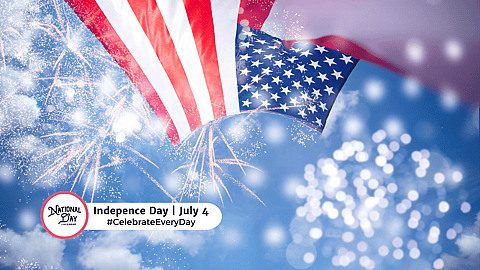
July 4, 2027 celebrates Independence Day, plus 3 more. Each year on July 4, the United States celebrates Independence Day. This federal holiday commemorates the adoption of the Declaration of Independence on July 4, 1776, declaring independence from the Kingdom of Great Britain.
National Day Calendar is celebrating Alice In Wonderland Day on July 4th to commemorate the date that Lewis Carroll first told his beloved story to Alice Liddell. Today's National Day is also the perfect opportunity to learn more about this English writer and how this famous children’s book came about.
National Caesar Salad Day on July 4 commemorates the time-honored tradition of the classic Caesar salad dressing. Though its distinct ingredients can make some people a bit squeamish, it remains one of the most popular salads in the world, boasting an undeniably legendary flavor profile.
Get the charcoals because July 4 is National Barbecued Spareribs Day across the nation. This delicious food holiday is one of the most popular food celebrations because anytime a grill and BBQ are involved, it's going to be a great day to gather family and friends.
Critically acclaimed writer who wrote several novels and short stories, including The Scarlet Letter.
1816
HW
Hiram Walker
Founder of the Hiram Walker and Sons Ltd. distillery in Windsor, Ontario, Canada Canadian Club whisky.
1826
SF
Stephen Foster
Songwriter and composer known as the "Father of American Music". He was known for writing his parlor and folk music, Oh! Susanna and My Old Kentucky Home.
1847
JA
James Anthony Bailey
Circus ringmaster and co-founder of Ringling Bros. and Barnum & Bailey Circus.
1867
SM
Stephen Mather
Conservationist who organized U.S. National Park Service.
1872
CC
Calvin Coolidge
The 30th President of the U.S. serving from 1923 to 1929. Prior to that, he served as the 29th Vice President serving from 1921 to 1923, under President Warren G. Harding.
1910
RK
Robert K. Merton
Considered the founder of Modern Sociology and a major contributor to the study of criminology.
1910
GS
Gloria Stuart
American actress known for her roles in pre-code films. She was later cast as Rose James Cameron's epic film Titanic, a role that renewed her fame late later in life.
1918
EP
Esther Pauline Lederer
Advise columnist who went by the pen name Ann Landers.
1918
PP
Pauline Phillips
Journalist and radio host who created the newspaper column Dear Abby. The column was the widely syndicated newspaper column in the world, syndicated in 1,400 newspapers with 110 million readers.
1950
SS
Steven Sasson
Electrical engineer and the inventor of the portable digital camera.
Historical Events on July 4
Events that occurred on July 4 throughout history
1776
1776
The Declaration of Independence is adopted.
The U.S. Declaration of Independence is adopted by the Second Continental Congress, severing ties for the 13 colonies from the British rule. However, New York did not sign the document until July 19 because delegation had not received approval on July 4.
1777
1777
The first Independence Day is celebrated in Philadelphia.
The first Independence Day is celebrated in Philadelphia. The celebration included ships firing 13-cannon salutes for the 13 colonies, parades, and fireworks.
1802
1802
West Point opens.
The U.S. Military Academy West Point opens in New York.
1803
1803
The U.S. government announces the Louisiana Purchase.
The U.S. government announces the Louisiana Purchase to citizens, informing them the country purchased 828,000 square miles of land from France for $15 million. The purchase guaranteed free navigation to expand the country westward.
1818
1818
The U.S. Flag Act of 1818 takes effect.
The U.S. Flag Act of 1818 goes into effect, creating a 13 stripe flag with a star for each of the 13 colonies. The Act also stated a star would be added for each state as they joined the Union.
1826
1826
Former Presidents Thomas Jefferson and John Adams both die 50 years after the Declaration of Independence is signed.
Former Presidents Thomas Jefferson and John Adams both die on the 50th anniversary of the Declaration of Independence. Jefferson was 83 years old and Adams was 90 years old. Both were Founding Fathers and signed the original document.
1827
1827
New York abolishes slavery.
Slavery is abolished in the State of New York. Roughly 4,600 slaves, both men and women, were freed.
1831
1831
Samuel Francis Smith writes "My Country, 'Tis of Thee"
Samuel Francis Smith writes "My Country, 'Tis of Thee" for the Boston, Massachusetts July 4 festivities. The hymn was considered the U.S. National Anthem until the Star Spangled Banner was written in 1931.
1855
1855
The first edition of Walt Whitman's book of poems is published.
The first edition of Walt Whitman's book of poems, Leaves of Grass, is published in Brooklyn.
1862
1862
Lewis Carroll tells his niece Alice Liddell a story entitled Alice's Adventures Under Ground.
Lewis Carroll tells his niece Alice Liddell a story entitled Alice's Adventures Under Ground. The title was later changed to Alice's Adventures in Wonderland for publishing.
1881
1881
The Tuskegee Institute opens in Alabama.
The Tuskegee Institute opens in Alabama as the first "normal" school to train Black teachers in the rural south.
1888
1888
The first organized organized rodeo competition is held in Arizona.
The first organized organized rodeo competition is held in Prescott, Arizona. The competition was the first to have rules, prizes, and categories for cowboys. Juan Leivas won the inaugural all-around professional title.
1913
1913
President Woodrow Wilson addresses American Civil War veterans.
President Woodrow Wilson addresses American Civil War veterans at the Great Reunion of 1913. President Wilson told the veterans, "We have found one another again as brothers and comrades in arms, enemies no longer, generous friends rather, our battles long past, the quarrel forgotten—except that we shall not forget the splendid valor."
1939
1939
Baseball legend Lou Gehrig announces his retirement after being diagnoses with ALS.
Baseball legend Lou Gehrig announces his retirement after being diagnoses with Amyotrophic lateral sclerosis (ALS). He tells a crowd at Yankee Stadium that he considers himself "The luckiest man on the face of the earth".
1950
1950
The American funded Radio Free Europe first broadcasts in Munich, West Germany.
The American funded Radio Free Europe first broadcasts in Munich, West Germany, kicking off the Cold War effort. The Radio program was primarily funded by the U.S. government through the CIA, but also everyday American people. Program recordings were made in New York, then flown overseas.
1966
1966
President Lyndon B. Johnson signs the Freedom of Information Act.
President Lyndon B. Johnson signs the Freedom of Information Act into United States law. The Act required federal agencies to make government records and documents available to the public and the press, legally establishing the public's right to access federal information. The Act didn't go into effect until the following year.
1970
1970
Casey Kasem's American Top 40 debuts.
Casey Kasem's American Top 40 debuts on seven radio stations in the U.S. During the show, Kasem played musical trivia and delivered human-interest stories. Each show ended with Kasem signing off with "Keep your feet on the ground, and keep reaching for the stars."
1997
1997
NASA lands on Mars.
NASA's Pathfinder space probe lands on the surface of Mars with the first ever robotic rover.
2004
2004
The cornerstone of the Freedom Tower is laid on the World Trade Center site.
The cornerstone of the Freedom Tower is laid on the World Trade Center site in New York City. The 20-ton slab placement was made of of Adirondack granite and had the inscription: "To honor and remember those who lost their lives on September 11, 2001 and as a tribute to the enduring spirit of freedom, July Fourth 2004."
2009
2009
The Statue of Liberty's crown reopens to the public after eight years of closure.
The Statue of Liberty's crown reopens to the public after eight years of closure due to security concerns following the September 11 attacks.
Also Happening This Month
Longer-running observances that include this date.


.png)


