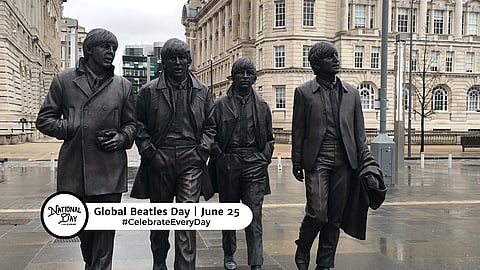
June 25, 2027 celebrates Global Beatles Day, plus 3 more. June 25 is a day someone may want to hold your hand and ask you to please, please be true because they love you yeah, yeah, yeah. Global Beatles Day or GBD commemorates The Beatles music and their shake-up of the music world.
Every year on the last Friday in June, British tradition comes alive on International Cream Tea Day (formerly National Cream Tea Day). This International Day celebrates a tradition enjoyed at social occasions, lawn parties, and with guests in your home.
The Day of the Seafarer on June 25 recognizes the valuable contribution seafarers make to international trade and the world economy. Let's take a little time today to honor those individuals that sail for long periods of time to provide us with goods.
Geneticist who discovered the X and Y chromosomes.
1874
RO
Rose O'Neill
The first published female cartoonist in the U.S. who rose to fame rose for creating the popular comic strip characters, Kewpies.
1929
EC
Eric Carle
Children's author and illustrator. He wrote The Very Hungry Caterpillar, The Grouchy Ladybug, and The Mixed-Up Chameleon.
1935
LK
Larry Kramer
Author, playwright, and activist who co-founded the Gay Men's Health Crisis organization.
1943
CS
Carly Simon
Singer, songwriter, musician, and author who rose to fame with his 1970s hit single That's the Way I've Always Heard It Should Be and You're So Vain.
1947
JW
Jimmie Walker
Good Times actor who played JJ Evans who is known for his catch phrase "Dynomite!"
1956
AB
Anthony Bourdain
Author and chef who traveled the world exploring cultures and food.
Historical Events on June 25
Events that occurred on June 25 throughout history
1630
1630
Governor John Winthrop introduced the first fork to Colonial America.
Governor Winthrop introduces the fork to American dining. However, Puritan colonists rejected the two-pronged utensil because they felt it was associated with Satan's pitchfork.
1788
1788
Virginia becomes the tenth state to ratify the Constitution.
Virginia becomes the tenth state to join the Union. The state was the largest of the 13 colonies and creating a federal government was pivotable to move forward with creating the Bill of Rights.
1867
1867
Lucien Smith patents the first barbed wire.
Lucien Smith patents the first barbed wire.
1868
1868
President Andrew Johnson signs a law establishing an 8-hour workday.
President Andrew Johnson signs a law establishing an 8-hour workday for government workers. President Johnson initially vetoed the law, but Congress overrode the veto, causing the President to sign.
1876
1876
Lieutenant Colonel George Armstrong Custer and 7th Cavalry Regiment are wiped out by the Sioux.
Lieutenant Colonel George Armstrong Custer and 7th Cavalry Regiment are wiped out by the 5,000 Sioux (Lakota, Cheyenne and Arapaho, led by Sitting Bull and Crazy Horse). The battle became known as "Custer's last Stand".
1910
1910
Congress passes the Mann Act.
The U.S. Congress passes the Mann Act, which criminalizes the transportation of women or girls across state lines or international borders for prostitution, debauchery, or "any other immoral purpose".
1913
1913
American Civil War veterans begin arriving at the Great Reunion of 1913.
American Civil War veterans begin arriving at the Great Reunion of 1913, for the 50th anniversary of the Battle of Gettysburg. Nearly 53,407 veterans from 46 of the then-48 states gathered to celebrate reconciliation after the Civil War..
1929
1929
President Herbert Hoover signed a proclamation declaring the Colorado River Compact effective.
President Herbert Hoover signed a proclamation declaring the Colorado River Compact effective. The legislation authorized construction of the Boulder Dam (Hoover Dam).
1934
1934
President Franklin D. Roosevelt signs the National Firearms Act into law.
President Roosevelt signs the National Firearms Act into law. The Act was originally created to require gun owners to register firearms to determine the excise tax. It also was an indirect step to expand the federal government's reach into criminal justice to crack down on rampant bootlegging, kidnappings, and gang violence.
1948
1948
Congress passes the Displaced Persons Act as a result of WWII.
President Harry S. Truman signs the Displaced Persons Act, allowing World War II refugees to immigrate to the United States above quota restrictions. Immigrants had to secure employment that wouldn't displace an American worker, have suitable housing, and provide a resident sponsor before arrival.
1978
1978
The rainbow flag representing gay pride is flown for the first time.
The rainbow flag representing gay pride is flown for the first time during the San Francisco Gay Freedom Day Parade.