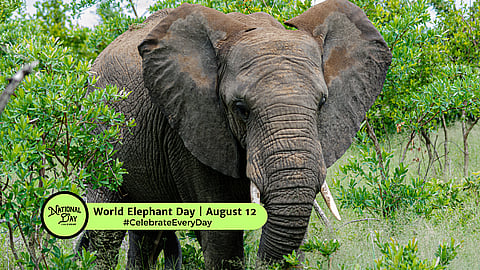
August 12, 2026 celebrates World Elephant Day, plus 1 more. Join in the worldwide observance on August 12 as we celebrate of one of Earth's most magnificent creatures on World Elephant Day.
Each year on August 12, we observe International Youth Day (IYD). On this day, we celebrate youth across the globe to honor the promising future in today's society. In addition, the day also brings worldwide awareness to issues youth face in their lives on a daily basis.
Scottish publisher and activist who co-founded the Guinness World Records with his twin brother Norris.
1925
NM
Norris McWhirter
Scottish publisher and activist who co-founded the Guinness World Records with his twin brother Ross.
1852
MJ
Michael J. McGivney
Priest and founder of the Knights of Columbus.
1591
LD
Louise de Marillac
Co-founder of the Daughters of Charity, an organization of women devoted to serving the poor through the corporal and spiritual works of mercy. Unlike other religious organizations at the time, the Daughters of Charity lived among the people it served.
1859
KL
Katharine Lee Bates
Poet and author known for writing America the Beautiful. She popularized the concept of Mrs. Claus in her poem Goody Santa Claus on a Sleigh Ride, introducing Santa's wife as a person who encourage, cared for, and helped Santa.
1929
BO
Buck Owens
Successful country music artist who was the lead singer for The Buckaroos.
1904
AN
Alexei Nikolaevich
The last Russian tsarevitch. He was the youngest child and only son of Tsar Nicholas II and Tsarina Alexandra Feodorovna. He was executed, along with the rest of his family, by Bolshevik revolutionaries.
Historical Events on August 12
Events that occurred on August 12 throughout history
1323
The Treaty of Nöteborg between Sweden and Novgorod Republic is signed. The Treaty created the border between the two countries for the first time. Nöteborg would eventually become a part of Russia.
1492
Christopher Columbus arrives in the Canary Islands to stock up on food and water, and load supplies before heading west across the Atlantic.
1516
France and Spain sign the Treaty of Noyon, giving Milan to France and Naples to Spain.
1851
Isaac Singer is granted a patent for his sewing machine. The design featured an overhanging arm, a rigid continuous feed, and a foot treadle that enabled operators to run the machine using hands-free and focus on guiding material to sew.
1865
British surgeon Joseph Lister performs the first antiseptic surgery in Glasgow, Scotland. Lister repaired a compound leg fracture on a young boy and prevented severe post-operative risk.
1883
The last quagga dies at the Natura Artis Magistra, a zoo in Amsterdam, Netherlands. Quaggas looked like a regular zebra in the front with stripes, but its back half was solid reddish-brown with no stripes. Severe hunting lead to their extinction.
1898
The Hawaiian flag is lowered from ʻIolani Palace and replaced with the flag of the U.S. to signify the transfer of sovereignty from the Republic of Hawaii to the U.S. formally recognizing the island as U.S. territory.
1914
Great Britain and France declared war on Austria-Hungary. France found itself at war due to its alliance with Russia. Great Britain joined after German forces violated Belgian neutrality and threatened France.
1944
Alençon becomes the first city in France to be liberated from Nazis occupation. The city had been under Nazi control since 1940.
1950
The North Korean Army massacres 75 American POWS after capturing soldiers from the 555th Field Artillery Battalion and the 90th Field Artillery Battalion. The war crime became known as the Bloody Gulch Massacre.
1960
NASA's first successful communications satellite is launched. Echo 1A, the world's first successful passive communications satellite, enabled the first two-way long-distance voice and signal relays. President Dwight D. Eisenhower pre-recorded an audio broadcast for testing.
1964
South Africa is banned from the Olympic Games due to the country's apartheid policies and racially segregated sports. The country was banned for over two decades. They were readmitted in 1991 ahead of the 1992 Barcelona Olympics.
1981
The IBM Personal Computer is released. The PC cost $1,565 for a basic setup and used an Intel 8088 processor and Microsoft's PC-DOS. It contained 16 KB RAM and came with a standard cassette tape interface. An upgrade option for a floppy disk drive was offered for an additional cost.
1984
The infamous Braves–Padres bean brawl occurred at the Atlanta-Fulton County Stadium between the Atlanta Braves and San Diego Padres. Both teams accused each other of "beaning," which is throwing the ball at an opposing player with the intention of striking them such as to cause harm. The game ended with 13 ejections and also 5 arrests.
1990
The largest and most complete Tyrannosaurus rex skeleton found to date was discovered in South Dakota. The T-Rex was found on the Cheyenne River Indian Reservation by Sue Hendrickson. It was 90% complete and measured over 42 feet long.
1992
Canada, Mexico and the U.S. announce completion of negotiations for the North American Free Trade Agreement (NAFTA). The goal of the agreement was to create a free trade zone by removing tariffs and trade barriers between the three nations.
1994
Major League Baseball players go on strike, eventually forcing the cancellation of the 1994 World Series. Owners of the league proposed a salary cap to their players wanting to "control" what a team could pay a player. Players protested to keep their right to choose a team with the best offer.