National Roast Dinner Day
Fast Facts
- WHAT
- Celebrates the hearty, slow-cooked comfort food known as the Roast Dinner
- WHEN
- Celebrated each year on November 4
- ORIGIN
- Originated in the UK, but celebrated globally
- VIBE
- Comfort, Family, Tradition
NATIONAL ROAST DINNER DAY
On November 4, food lovers across the globe gather around the table for National Roast Dinner Day! This food holiday may have started in the UK from a British tradition, but deserves an international celebration of hearty, slow-cooked comfort food.
#NationalRoastDinnerDay
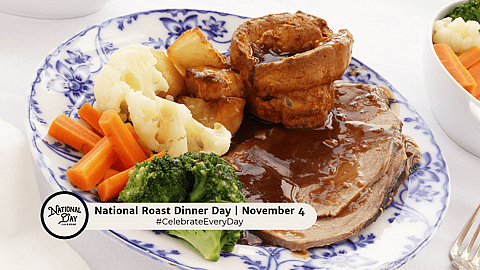
A traditional British roast dinner is far more than meat and potatoes--it's a coordinated feast of distinct flavors and textures. Imagine sitting down to a feast of crispy roasted meats, golden potatoes, seasonal veggies, and a rich gravy. National Roast Dinner Day taps into that universal instinct to slow down, let an oven warm the house, and share a generous platter with family or friends.
Traditional Roast Dinner
-
Tender roast beef, lamb with mint sauce, or roasted chicken with a delicious herb stuffing.
-
Parboiled potatoes, shaken in a colander to rough up the edges, and roasted in hot fat until the exterior shatters like glass while the interior stays fluffy.
-
Yorkshire pudding made from a simple batter of eggs, flour, and milk poured into smoking-hot tins to create crisp, puffy, hollow vessels meant to catch excess sauce.
-
Glazed carrots, tender parsnips, or braised cabbage.
-
Piping-hot pan gravy made from the juices of the meat, tying the entire plate together.
Historical Significance of Roast Dinner
The British roast dinner is an institution shaped by religious liturgy, royal pageantry, industrialization, and working-class resourcefulness over several centuries. Christian customs prohibited manual labor on the Sabbath, so many observant households refrained from lighting cooking fires or tending hearths during church hours.
Working-class families would instead drop off a pot containing meat and potatoes at the local bakery. Bakers did not bake bread on Sundays, so they let the townspeople cook their dinners in the cooling brick ovens. Families collected their pot fully roasted in time for the post-service midday meal.
Medieval England
The tradition of the roast dinner can be traced back to Medieval England. After working six days a week for land-owning lords, laborers were mandated to rest on Sunday to attend church. Afterwards, feudal lords frequently treated their laborers to a feast for all their hard word during the week.
15th Century
During the 15th century, roast beef had become so entwined with national strength that King Henry VII’s royal bodyguards were nicknamed the "Yeomen Warders" or "Beefeaters." Eating roast beef daily meant physical vigor and crown prosperity.
18th Century
By the 18th century, Henry Fielding's patriotic ballad "The Roast Beef of Old England" cemented the dish as a cultural symbol contrasted against the delicate broths and sauces of mainland Europe.
Industrial Revolution
During the Industrial Revolution, the roast dinner became the economic linchpin of household budgeting. Meat was an expensive luxury, and a Sunday roast dinner was expected to feed a working family for the entire week with sandwiches, Shepherd's pie, and stews.
HOW TO CELEBRATE NATIONAL ROAST DINNER DAY
-
Host a British "Sunday Pub Lunch" by creating an atmosphere of an authentic British gastropub. Play laid-back acoustic music, use rustic wooden boards, and keep the lighting warm. Serve a classic British beverage with your meal, such as English bitter, an amber ale, or a hearty red wine. Serve all of the traditional foods with English mustard and creamy horseradish or mint sauce. Don't forget the oversized jug of gravy!
-
Master the roast potato technique. Parboil your potatoes and shake them vigorously in a colander, then fry them in duck/goose fat, beef tallow, olive oil or vegetable oil with crushed garlic and rosemary. A successful traditional roast potato will be extra crispy on the outside and fluffy on the inside.
-
Create a Yorkshire pudding bar. Bake individual Yorkshire puddings using large ramekins or a 4-cup popover/giant muffin tin so they form deep, bowl-like hollows. Set them out like edible bowls and let guests fill their own with different fillings, such as beef, chicken, braised mushrooms, roasted roots, mushy peas, and ladles of piping-hot onion or red wine gravy.
-
Learn about the history of the roast dinner. The tradition can be traced back to Medieval times, that's nearly 1,000 years of information to retain!
-
Share your roast dinner recipes and photos of you and your family on social media using the hashtag #NationalRoastDinnerDay.
CREATOR OF NATIONAL ROAST DINNER DAY
National Roast Dinner Day was created in 2010 by the Soil Association through its Food for Life initiative in the UK to raise awareness about two specific social and educational purposes:
Promote healthy school lunches to ensure students were getting fresh, locally sourced and food into schools, nurseries, hospitals, and care homes across Britain.
Connecting communities through food by inviting parents, grandparents, local farmers, and community leaders into primary and secondary schools to sit down with pupils and eat a freshly prepared, nutritious school dinner together.
The creators aimed to demonstrate that school cafeterias could serve scratch-cooked, wholesome meals made with seasonal, sustainably farmed ingredients rather than cheap, ultra-processed alternatives. Over time, the celebration expanded beyond school dining halls into pubs, family homes, and online food communities across the UK and abroad.