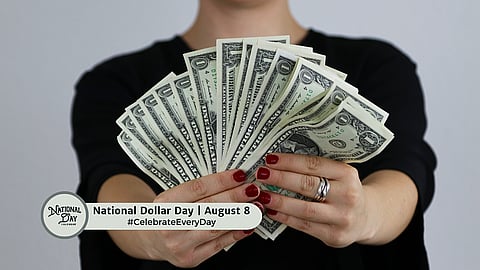
NATIONAL DOLLAR DAY
Fast Facts
- CELEBRATION
- Commemorates the founding of the U.S. monetary system by the Continental Congress in 1786
- CELEBRATED
- Each year on August 8
- FACT
- Salmon P. Chase, President Lincoln's Secretary of Treasury, was the first person on the $1 bill.
- VIBE
- Historical, collectable, informational
NATIONAL DOLLAR DAY
Every year on August 8, National Dollar Day commemorates the founding of the U.S. monetary system by the Continental Congress in 1786. From silver certificates to modern greenbacks, the U.S. dollar has evolved into one of the world's most recognizable currencies.
#NationalDollarDay
When the Continental Congress established the monetary system on August 8, 1786, it adopted a decimal-based system centered around the dollar. However, paper currency as we know it today arrived much later.
During the American Civil War, the federal government issued its first official one-dollar paper note in 1862. Notably, George Washington was not on this original note—instead, it featured Salmon P. Chase, President Abraham Lincoln's Secretary of the Treasury. Washington's portrait was not added to the $1 bill until 1869.
Decoding the Dollar
The back of the dollar bill features the two sides of the Great Seal of the United States, loaded with historical symbolism. The design explicitly honors the original 13 American colonies:
13 steps on the unfinished pyramid.
13 arrows held in the eagle's left talon (representing war).
13 leaves and 13 olives on the olive branch in its right talon (representing peace).
13 stars in the constellation above the eagle's head.
13 stripes on the eagle's shield.
The Latin Mottos:
Annuit Coeptis translates to "He [God] has favored our undertakings,"
Novus Ordo Seclorum, beneath the pyramid, translates to "A new order of the ages."
The Roman numerals at the base of the pyramid (MDCCLXXVI) represent 1776, the year of the Declaration of Independence.
A popular rumor claims a microscopic owl or spider is hidden in the webbed border pattern near the top-right numeral "1" on the dollar bill. However, the Bureau of Engraving and Printing clarifies that this is simply a natural overlap in the geometric fine-line lathe work designed to make copying difficult.
HOW TO OBSERVE NATIONAL DOLLAR DAY
-
Track your money and use the tracking website Where's George? to log a bill's serial number and see where it travels across the globe.
-
Visit an official Treasury or Federal Reserve Museum site to learn how currency manufacturing has shifted from hand-engraved plates to high-speed digital printing.
-
Use today to set aside $1 daily toward a financial goal. Write down the value of your goal and deduct $1 a day until you've saved enough.
-
Use the U.S. Currency Education Program's $1 Note Overview learn about every feature of a $1 bill. The overview is interactive and allows you to click on every element to learn what it is and what it means.
-
Share your $1 bill facts on social media using the hashtag #NationalDollarDay.
NATIONAL DOLLAR DAY HISTORY
We were unable to identify the creator of National Dollar Day. However, the origins are clearly related to the establishment of the U.S. monetary system on August 8, 1786.
$1 FAQs
Whose image is on the one-dollar bill?
George Washington
What can I buy for a dollar?
We found a few things you can still buy for $1:
Lipstick
Glue sticks
Acrylic Paint
Barrettes
Candy
Socks
Scissors
Nail Polish
Canned & Frozen Fruits & Vegetables
Lemon or lime
Plastic Bandages
Seasonings
Chew toy
Was the minimum wage ever a dollar?
Yes. Until September 3, 1961, the minimum wage was $1 or less. The lowest minimum wage enforced was $0.25.
What is the most collectible one-dollar bill?
Rare dollar bills with repeating sequences or misprints are the most collectible.
Shop this day
What's Next