NATIONAL ARKANSAS DAY

NATIONAL ARKANSAS DAY
On January 11th, National Arkansas Day recognizes the Natural State and the 25th state to join the union. Unlike the June 15 celebration called Arkansas Statehood Day, which is celebrated as the state's anniversary, National Arkansas Day give us an additional day to honor Arkansas' in history, culture, food, and the people who make up The Natural State.
Understanding National State Days
Why do we have National State Days?
National Day Calendar is committed to celebrating every aspect of our nation's diverse culture and history, which is why we proudly introduced National State Days. This initiative is our way of honoring each state in the order they joined the Union, offering a dedicated day to celebrate the unique heritage, achievements, and spirit of each state.
By assigning individual days to each state, we're fostering a deeper understanding and appreciation of what makes each part of our nation unique. We invite you to join us in these celebrations, to explore, learn, and take pride in the rich tapestry that makes up our country.
Why is the date different from founding dates of states?
National State Days on the National Day Calendar aren't set on the actual founding dates of each state. Our goal was to ensure that each state receives its special day of celebration without overlapping with others. Historical entry dates into the Union often mean multiple states share the same founding date, like North and South Dakota. To give every state its own spotlight, we decided to stagger the celebrations throughout the year.
When did National Day Calendar start National State Days?
National State Days were published on www.nationaldaycalendar.com in 2017. The celebrations begin seven days after Independence Day, starting with Delaware, which was the first state to join the Union. This delay allows for a distinct separation from the nationwide July 4th celebrations, ensuring each state's day is its own unique event.
Each subsequent state is honored weekly, in the order they joined the Union, not when the state celebrates their founded date. This weekly cadence allows for consistent and focused celebrations, ensuring each state can plan and enjoy its special day to the fullest.
We've made exceptions for the weeks of Thanksgiving and Christmas, recognizing that these times are already rich with tradition and celebration. We want every National State Day to have the opportunity for full attention and participation.
#NationalArkansasDay
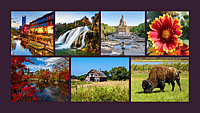
Arkansas teems with streams, lakes, and rivers, with its eastern border on the Mississippi River. Little Rock may be its capital, but state is also known for big rocks and minerals. It's the Quartz Crystal Capital of the World, has the only diamond mine in the U.S., and the Magnet Cove region contains 102 varieties of minerals.
Arkansas earns the name "Natural State" with over half the state covered with forests, including more than 1 million acres in Ozark National Forest. Hot Springs National Park became America's first national preserve in what later became the National Park System. In fact, after officials recognized the unique qualities of the hot springs, President Andrew Jackson signed legislation on April 20, 1832, protecting four sections of land, which included the hot springs and adjacent mountains.
What's in a Name
When Arkansas first became a state in 1836, how to pronounce the name of the 25th state was up for debate. Was it Arkan-saw or Ar-kansas? The issue was settled in 1881 when the State General Assembly passed Concurrent Resolution No.4. It stated the state's name would be pronounced Arkan-saw and spelled Arkansas.
Many who have called Arkansas home have left marks on our hearts and minds. From the legendary Johnny Cash and talented composers, Scott Joplin, and Roberta Martin, to authors Ernest Hemmingway and Maya Angelou and many more found a home at some time in Arkansas.
Nestled along the Mississippi River, Arkansas swells with delta, Civil War era, the blues and jazz, and Western migration history. The worst maritime disaster in United States history occurred on the Mississippi River just north of Marion, Arkansas. Greater than the Titanic disaster, the Sultana steamboat exploded on April 27, 1865, just weeks after the end of the Civil War and the assassination of President Lincoln. Over 1,800 souls perished.
HOW TO OBSERVE NATIONAL ARKANSAS DAY
Join National Day Calendar as we recognize Arkansas' natural beauty and fascinating history. Uncover hidden treasures and soak up all of Arkansas' impressive views! Use #NationalArkansasDay to share on social media.
For a complete list of Arkansas State and National Parks & Historic Sites visit www.arkansasstateparks.com and www.nps.gov. Check out a few of the featured sites around the state below.
Buffalo - Harrison and St. Joe
https://www.nps.gov/hosp/index.htm
Crater of Diamonds State Park - Murfreesboro
Lake Frierson State Park - Jonesboro
Louisiana Purchase State Park - Brinkley
Mark's Mills Battleground State Park - Fordyce
Mammoth Spring State Park - Mammoth Spring
Mount Nebo State Park - Dardanelle
Toltec Mounds Archeological State Park - Scott
MUSEUMS
Sultana Disaster Museum - Marion
Historic Arkansas Museum - Little Rock
Crystal Bridges Museum of American Art - Bentonville
Arkansas Inland Maritime Museum - Pulaski County
Museum of Native American Histoy - Bentonville
Delta Cultural Center - Helena
Gangster Museum of America - Hot Springs
Arkansas Air & Military Museum - Fayetteville
Delta Gateway Museum - Blytheville
Japanese American Internment Museum - McGehee
Esse Purse Museum - Little Rock
Tripoints - Arkansas/Missouri/Oklahoma
John Alexander Hanks was best 1st African American officer to hold a regular command position and the 2nd to graduate from the United States Military Academy at West Point.
During World War II, Gen. Douglas MacArthur commanded troops in the Pacific theater. In 1950, Gen. MacArthur temporarily led forces during the Korean War, until President Truman replaced him with Gen. Matthew Ridgeway in 1951.
One of the founding members of the Ninety-Nines, Louise Thaden, set speed, altitude and endurance records as one of the earliest female pilots. During World War II she served in the Civil Air Patrol.
Best known as the football coach at the University of Alabama from 1958-1982, Paul William Bryant set a record as the winningest collegiate coach. While the record has since been broken, a majority of those wins came during his time coaching for his alma mater, The University of Alabama.
Considered the Godmother of Rock & Roll, Sister Rosetta Tharpe's spiritual gospel vocals against the background of her signature electric guitar inspired many Hall of Fame inductees.
Publisher and business leader, John Harold Johnson launched his own publishing company in 1942 which produced Negro Digest, Ebony and Jet.
Drafted by the Detroit Lions in 1940, Maurice Britt's career headed into high gear. Then in 1941, he was drafted once again - by the United States Army. Britt went on to become the first army man in United States history to receive the three highest combat awards in a single war. He earned the Distinguished Service Cross, the Medal of Honor and the Silver Star among many other awards.
Following the war, Britt served his home state as Lt. Governor for two terms.
Samuel Kountz's pioneering organ donation research took kidney transplants out of the realm of experimental and into standard practice. From extending the life of donor kidneys to innovative devices, Kountz's work has transformed the lives of those with renal failure.
Known as the Man in Black, Johnny Cash's music career spanned more than four decades. While he suffered addiction and setbacks, Cash's legendary voice and storytelling ability spoke volumes to his fans.
Nominated as the first African American Surgeon General of the United States, Joycelyn Elders served from September 1993 to December 1994.
Serving as the 42nd President of the United States, William Jefferson Clinton was elected to two terms in office. He was the first democratic president to serve two consecutive terms since Franklin D. Roosevelt.
Shop this day
What's Next